From Wikipedia, the free encyclopedia
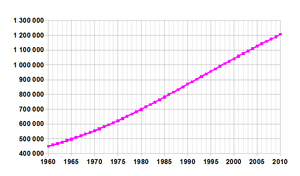
Population growth, from 443 million in 1960 to 1,004 million in 2000
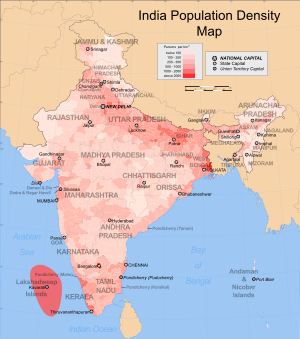
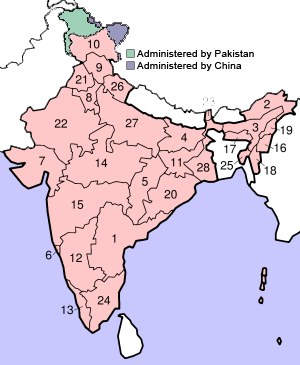
Map showing the population density of each district in India
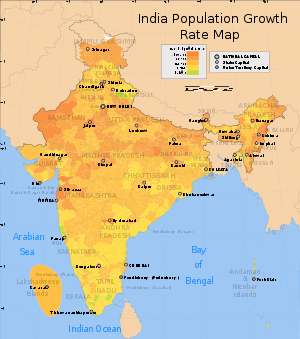
Map showing the population growth over the past ten years of each district in India
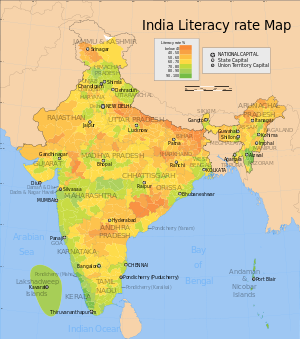
Map showing the literacy rate of each district in India
Chart showing the Total Fertility Rate of Indian states (SRS survey 1996-98)[1]
India has a population of approximately 1.136 billion people (estimate for September 1, 2007 based on interpolating on estimates by Census Bureau of India for March 1 of 2007 and 2008), comprising approximately one-sixth of the world's population. This population is remarkably diverse; it has more than two thousand
ethnic groups, and every major religion is represented, as are four major
families of languages (Indo-European, Dravidian, Austro-Asiatic and Tibeto-Burman languages) as well as a language isolate (the Nihali language[2] spoken in parts of Maharashtra). Further complexity is lent by the great variation that occurs across this population on social parameters such as income and education. Only the continent of Africa exceeds the linguistic, cultural and genetic diversity of India.[3] These factors render the task of comprehensively detailing the Demographics of India prohibitive; some important indices are available, nevertheless.
Salient features
Although
India occupies only 2.4% of the world's land area, it supports over 16% of the world's population. 31.8% of Indians are younger than 15 years of age.[4] As per the 2001 census, 72.22% of the people live in more than 550,000 villages, and the remainder in more than 2000 towns and cities.[citation needed][5]
Although 80.5% of the people are Hindus,[6] India is also home to the third-largest Muslim population in the world 13.4% after Indonesia and Pakistan. India also contains the majority of the world's Zoroastrians, Sikhs and Jains. Other religious groups include Christians (2.3%), Buddhists (0.8%), Jews and Bah�'�s.[7]
Census
The most recent
census of India was performed in 2001 for enumeration as of March 1 of that year.[8] It was the 14th census in an unbroken series, and the 6th after independence in 1947 (with the exception that census could not be held for Assam in the 1981 and Jammu & Kashmir in 1991). Eight censuses were performed under the British Raj, the first one was carried out throughout the 1860s and completed in 1872. After this, there has been 'one census every decade starting 1881'.
The 2001 census was conducted in two phases, the first being Housenumbering and Houselisting operations, carried out in May 2000, and the second being population enumeration, carried out from February 9 to 28, 2001. The reference time for the census is 1 March, 2001. The homeless population was enumerated on 28 February. A revisional round was undertaken 1 to 5 March 2001 to account for mutations between the time of visit in February and 1 March.[citation
needed]
The total population calculated for 1 March 2001 was 1,027,015,247, making the 2001 census the first to count more than a billion Indians.[9] The population had risen by 21.34% compared to the 1991 total. The female population had increased by 0.3 percentage points to 48.4%.[10]
See list of States of India by urban population. Maharashtra has the largest urban agglomeration while Delhi is the most urbanised market at over 93% urbanization.
There are several nomadic communities found in all over India. Their population is not estimated in India, but it is supposed that they make up 7% of total population of India[citation needed].
Key data
Total Population: 1,129.9 million(July 1, 2007 est. CIA)[11]
1,028.7 million(2001 Census final figures, March 1 enumeration and estimated 124 thousand in areas of Manipur that could not be covered in the enumeration)
Rural Population: 72.2%, male: 381,668,992, female: 360,948,755 (2001 Census)
Table 1: Population History
| Year |
Total Population |
| 1960 |
443,000,000 |
| 1970 |
553,000,000 |
| 1980 |
684,000,000 |
| 1990 |
838,141,000 |
| 2000 |
1,004,591,054 |
| 2005 |
1,095,054,669 |
| 2007 |
1,129,866,154 |
Table 2: Population Projections (in millions)
| Year |
Under 15 |
15-64 |
65+ |
Total |
| 2000 |
361 |
604 |
45 |
1010 |
| 2005 |
368 |
673 |
51 |
1093 |
| 2010 |
370 |
747 |
58 |
1175 |
| 2015 |
372 |
819 |
65 |
1256 |
| 2020 |
373 |
882 |
76 |
1331 |
Source: Based on P.N. Mari Bhat, "Indian Demographic Scenarion 2025", Institute of Economic Growth, New Delhi, Discussion Paper No. 27/2001.
Urban Population: Age structure:
0-14 years: 30.8%, male: 188,208,196, female: 171,356,024
15-64 years: 64.3%, male: 386,432,921, female: 364,215,759
65+ years: 4.9%, male: 27,258,259, female: 30,031,289 (2007
est.) The average age of Indians is 24.8 years.
Population growth rate: 1.38% (2007 est.)
Birth rate: 22.69 births/1,000 population (2007 est.)
Death rate: 6.58 deaths/1,000 population (2006 est.)
Literacy rate: 79,9% (2007 est.)[12]
Percent of the population under the poverty line: 22% (2006 est.)
Unemployment Rate: 7.8%
Net migration rate: − -0.05 migrant(s)/1,000 population (2007 est.)
Sex ratio:
at birth: 1.12 male(s)/female
under 15 years: 1.098 male(s)/female
15-64 years: 1.061 male(s)/female
65 years and over: 0.908 male(s)/female
total population: 1.064 male(s)/female (2006 est.)
Infant mortality rate: total: 34.61 deaths/1,000 live births (2007 est.) female: 29.23 deaths/1,000 live births male: 39.42 deaths/1,000 live births
Life expectancy at birth:
total population: 68.59 years
male: 66.28 years
female: 71.17 years (2007 est.)
Total fertility rate: 2.81 children born/woman (2007 est.) The TFR (Total number of children born per women ) according to Religion in 2001 was : Hindus - 2.27, Muslims - 3.06, Sikhs - 1.86, Christians - 2.06, Buddhists - 2.29, Jains - 1.50 , Animists and Others - 2.99, Tribals - 3.16, Scheduled Castes - 2.89.[13]
Nationality:
noun: Indian(s)
adjective: Indian
Religions: Hindu 82.5%, Muslim 11.4%, Christian 2.31%, Buddhists 0.8%, Sikh 1.93%, Jains 0.41%, others or not stated 0.76% (2001 Census)[citation needed]
Scheduled Castes and Tribes: Scheduled Castes: 16.2% (2001 Census) Scheduled Tribes: 8.2% (2001 Census)
Languages: See
Languages of India and
List of Indian languages by total speakers. There are 216 languages with more than 10,000 native speakers in India. The largest of these by far is Hindi
with some 337 million (the second largest being Bengali with some 207 million). 22 languages are recognized as "official languages". In India, there are 1,652 languages and dialects in total.[14][15]
Religious breakdown
-
Censuses were conducted in parts of India in the ancient times with examples such as Kautilya's Arthashastra which describes the collection of population statistics for taxation in 4th century B.C.. The British census in 1865-1872 was the first conducted in modern times in India.
The 2001 census figures released by the India Census Commission give a breakdown by various parameters including religion.
- All figures in %.
- Gender Ratio*: no of females/1000 males
- Others including Bah�'�s,
Jews, and
Parsis.
- Tribal Animists (and non religious) are grouped under Others after 1926 (1931 census onwards)
Table 2: Census information for 2001[α][β]
| Composition |
Hindus[16] |
Muslims[17] |
Christians[18] |
Sikhs[19] |
Buddhist[20] |
Jains[21] |
Others[22] |
| % total of population 2005 |
80.5 |
13.4 |
2.3 |
1.9 |
0.8 |
0.4 |
0.6 |
| 10-Yr Growth % (est '91-'01)[23][β] |
20.3 |
29.5 |
22.6 |
18.2 |
24.5 |
26 |
103.1 |
| Sex ratio* (avg. 944) |
935 |
940 |
1009 |
895 |
955 |
940 |
100 |
| Literacy rate (avg. 79.9) |
75.5 |
60.0 |
90.3 |
70.4 |
73.0 |
95.0 |
50.0 |
| Work Participation Rate |
40.4 |
31.3 |
39.7 |
37.7 |
40.6 |
32.9 |
48.4 |
| Rural sex ratio[23] |
944 |
953 |
1001 |
895 |
958 |
937 |
995 |
| Urban sex ratio[23] |
922 |
907 |
1026 |
886 |
944 |
941 |
966 |
| Child sex ratio (0-6 yrs) |
925 |
950 |
964 |
786 |
942 |
870 |
976 |
Source: The First Report on Religion: Census of India
2001[24]
α. ^
The data excludes Mao-Maram, Paomata and Purul subdivisions of
Senapati District of
Manipur β. ^
The data is "unadjusted" (without excluding
Assam and
Jammu and Kashmir); 1981 census was not conducted in Assam and 1991 census was not conducted in Jammu and Kashmir
It should also be noted that about 40% of the Hindus speak Hindi while the rest speak Bengali, Telugu, Marathi, Tamil, Gujarati,Kannada and other languages. Almost 70% of the Muslims speak Urdu while the rest speak Kashmiri, Bengali, Malayalam, Tamil, Gujarati and other languages. About one-third of the Christians speak Malayalam, one-sixth speak Tamil while the rest speak a variety of languages.
Ethnic groups
Unlike the
USA, UK, and Australian Censuses, the national Census of India does not recognize racial or ethnic groups within India,[25] but recognizes many of the tribal groups as Scheduled Castes and Tribes (see list of Scheduled Tribes in India).
It should be noted that
Indo-Aryan, Austro-Asiatic and Tibeto-Burman are racial and linguistic terms and denote members of these racial groups and speakers of their linguistic groups.
See also
References
-
^
http://www.unescap.org/esid/psis/population/database/poplaws/law_india/indiaappend3.htm
-
^ SIL International.
Ethnologue report for Language Isolate. Retrieved on
2007-10-11.
-
^
India, a Country Study United States Library of
Congress, Note on Ethnic groups
-
^
https://www.cia.gov/library/publications/the-world-factbook/geos/in.html#People
-
^
http://www.censusindia.net/results/rudist.html
-
^
https://www.cia.gov/library/publications/the-world-factbook/geos/in.html#People
-
^
http://www.censusindia.net/religiondata/
-
^
http://www.censusindia.net
-
^
http://www.censusindia.net/results/resultsmain.html
-
^
http://www.censusindia.net/results/
-
^
CIA World Factbook - India
-
^
http://www.censusindia.net/results/provindia3.html
-
^
http://www.censusindia.net/results/fseries_tables/data_highlights_F9_F10.pdf
-
^
Mother Tongues of India According to the 1961 Census
-
^ Rupert Goodwins.
Smashing India's language barriers. ZDNet UK.
-
^
Tables: Profiles by main religions: Hindus (PDF). Census
of India 2001: DATA ON RELIGION. Office of the Registrar
General, India. Retrieved on
2007-04-17.
-
^
Tables: Profiles by main religions: Muslims (PDF).
Census of India 2001: DATA ON RELIGION. Office of the
Registrar General, India. Retrieved on
2007-04-17.
-
^
Tables: Profiles by main religions: Christians (PDF).
Census of India 2001: DATA ON RELIGION. Office of the
Registrar General, India. Retrieved on
2007-04-17.
-
^
Tables: Profiles by main religions: Sikhs (PDF). Census
of India 2001: DATA ON RELIGION. Office of the Registrar
General, India. Retrieved on
2007-04-17.
-
^
Tables: Profiles by main religions: Buddhists (PDF).
Census of India 2001: DATA ON RELIGION. Office of the
Registrar General, India. Retrieved on
2007-04-17.
-
^
Tables: Profiles by main religions: Jains (PDF). Census
of India 2001: DATA ON RELIGION. Office of the Registrar
General, India. Retrieved on
2007-04-17.
-
^
Tables: Profiles by main religions: Other religions (PDF).
Census of India 2001: DATA ON RELIGION. Office of the
Registrar General, India. Retrieved on
2007-04-17.
- ^
a
b
c
A snapshot of population size, distribution, growth and socio
economic characteristics of religious communities from Census
2001 (PDF). Census of India 2001: DATA ON RELIGION
pp1-9. Office of the Registrar General, India. Retrieved on
2007-04-20.
-
^
Tables: Profiles by main religions.. Census of India
2001: DATA ON RELIGION. Office of the Registrar General,
India. Retrieved on
2007-04-17.
-
^ Kumar, Jayant. Census of India. 2001. September 4,
2006.
http://www.censusindia.net/.
External links









 pdf
pdf